
Bank of Canada rate announcements are some of the most closely watched events in the Canadian mortgage market. Whether you’re buying a home, renewing a mortgage, refinancing, or simply trying to understand where rates are headed, these decisions can influence your borrowing costs and financial planning.
However, many Canadians misunderstand what the Bank of Canada actually controls and how quickly mortgage rates respond. A Bank of Canada announcement doesn’t automatically mean mortgage rates change overnight.
Here’s what borrowers should know about Bank of Canada rate decisions and how they can impact your mortgage.
What is a Bank of Canada rate decision?
A Bank of Canada rate decision is when Canada’s central bank announces whether it will increase, decrease, or hold its target overnight rate.
The overnight rate is the interest rate financial institutions use when lending money to one another for short periods.
While consumers don’t borrow directly at this rate, it influences:
- Prime lending rates
- Variable mortgage rates
- Home equity lines of credit (HELOCs)
- Personal lines of credit
- Business borrowing costs
This is why every Bank of Canada announcement receives significant attention from homeowners, buyers, lenders, and investors.
What does the Bank of Canada actually control?
One of the biggest misconceptions is that the Bank of Canada directly controls all mortgage rates.
It doesn’t.
The Bank of Canada primarily controls:
- The overnight lending rate
- Monetary policy
- Inflation management
Variable mortgage rates are heavily influenced by these decisions because lenders often adjust their prime lending rates after a change to the overnight rate.
Fixed mortgage rates work differently.
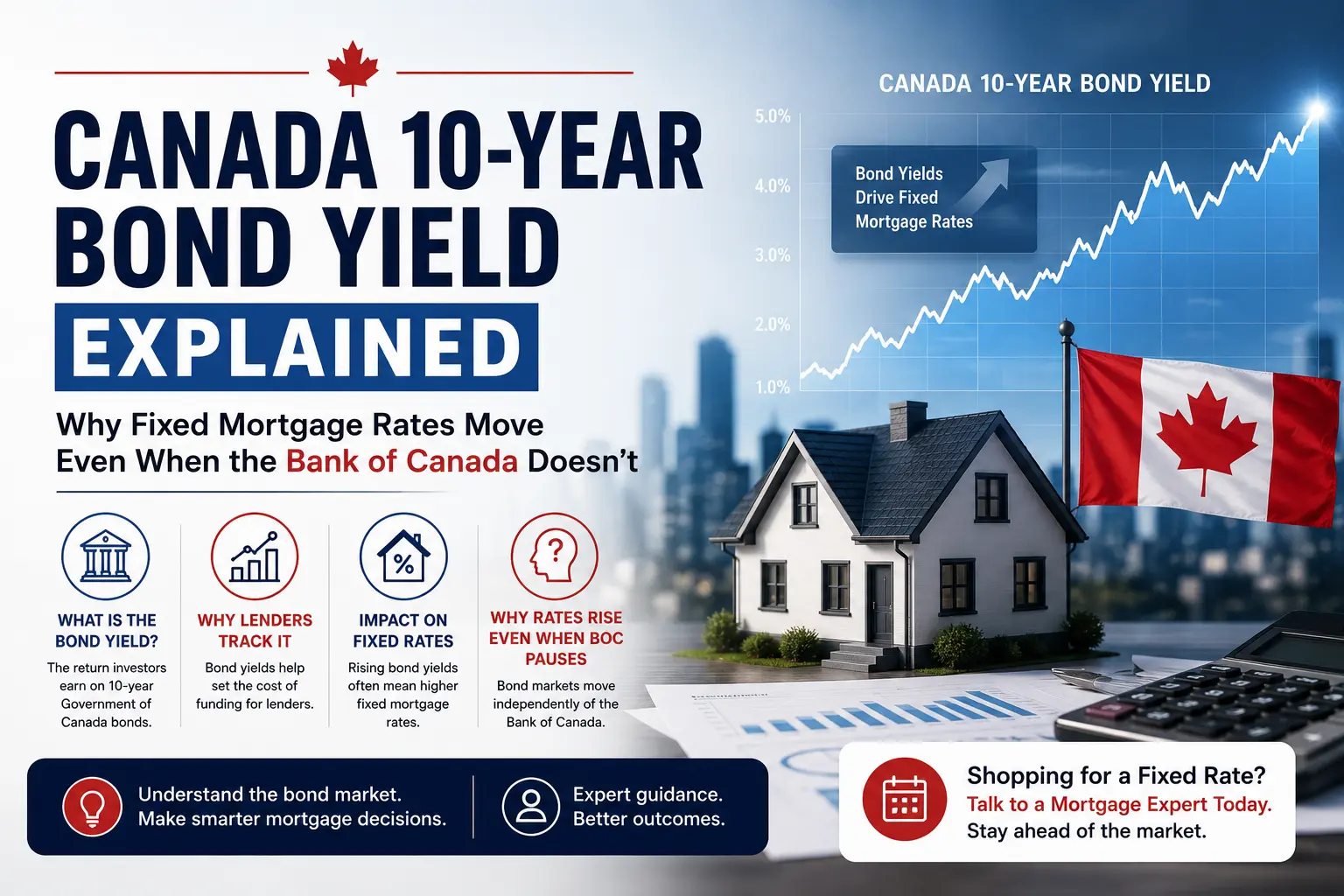
Fixed mortgage pricing is largely influenced by:
- Government of Canada bond yields
- Inflation expectations
- Economic growth forecasts
- Global financial markets
This explains why fixed rates sometimes rise even when the Bank of Canada is cutting rates.
Bank of Canada announcement schedule
The Bank of Canada typically announces rate decisions eight times per year on a predetermined schedule.
These announcement dates are published well in advance and become key milestones for:
- Home buyers
- Mortgage renewals
- Real estate professionals
- Financial markets
In the weeks leading up to each announcement, economists, lenders, and investors analyze economic data to predict the Bank’s next move.
Markets often begin pricing in expected decisions before the official announcement occurs.
Why mortgage rates don’t move instantly
Many borrowers expect mortgage rates to change the moment the Bank of Canada makes an announcement.
In reality, the process is more complicated.
For variable-rate mortgages
If the Bank of Canada changes the overnight rate, lenders typically review their prime rates shortly afterward.
Most major lenders respond within days, though timing can vary.
If prime rates change:
- Variable mortgage rates may change
- HELOC rates may change
- Line of credit rates may change
For fixed-rate mortgages
Fixed mortgage rates don’t automatically follow Bank of Canada announcements.
Instead, they react primarily to bond markets.
In many cases:
- Bond yields move before the announcement
- Markets price expectations in advance
- Fixed rates may already reflect expected changes
This is why some borrowers are surprised when fixed mortgage rates barely move after a major Bank of Canada decision.
How lenders react after a Bank of Canada rate decision
Following a Bank of Canada announcement, lenders assess:
- Economic outlook
- Inflation trends
- Bond market activity
- Competitive pressures
- Funding costs
Some lenders react immediately.
Others wait to see how broader markets respond.
This means borrowers can occasionally see slight differences between lenders in the days following a major announcement.
Mortgage pricing isn’t always uniform across the industry.
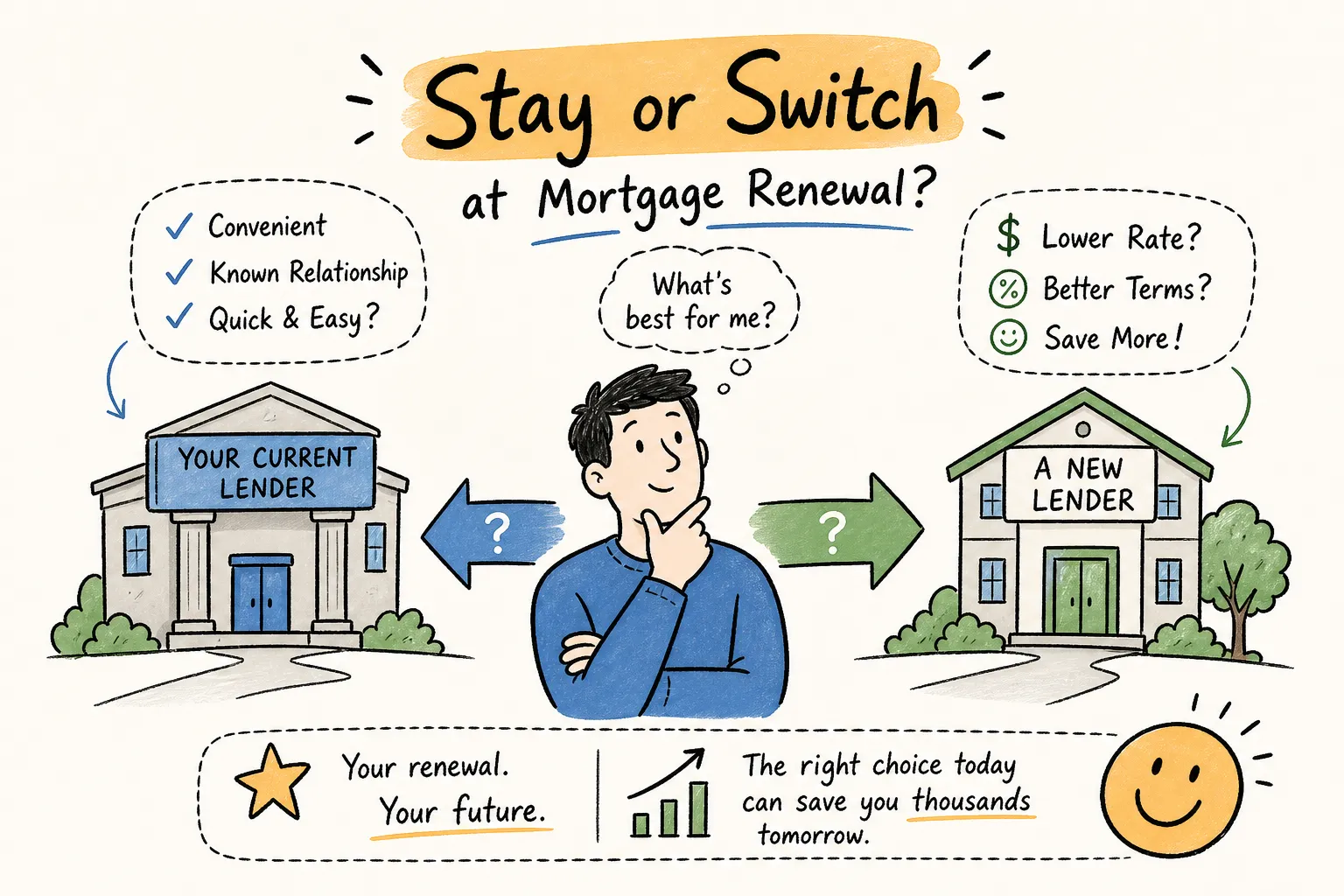
How Bank of Canada rate decisions affect mortgage renewals
If your mortgage renewal is approaching, Bank of Canada announcements become particularly important.
Renewing borrowers should pay close attention because:
- Variable mortgage pricing may change
- Fixed rates can shift based on bond yields
- Lender promotions may change
- Rate holds can become valuable
Many borrowers make the mistake of waiting until the last minute.
Shopping early gives you:
- More lender options
- More negotiating power
- Potential rate protection
In many cases, lenders can hold rates for up to 120 days.
How Bank of Canada rate decisions affect home buyers
For home buyers, rate decisions can influence both affordability and qualification.
Lower rates may:
- Improve affordability
- Reduce monthly payments
- Increase purchasing power
Higher rates may:
- Reduce borrowing capacity
- Increase qualification challenges
- Raise monthly payment costs
However, interest rates are only one piece of the affordability puzzle.
Home prices, income, debt levels, and the mortgage stress test also play major roles in determining what buyers can afford.
What borrowers should do before a Bank of Canada rate decision
1. Review your mortgage timeline
Ask yourself:
- Are you buying soon?
- Renewing soon?
- Refinancing soon?
Your timeline determines how much impact a rate decision may have on your plans.
2. Get pre-approved
A mortgage pre-approval can often secure a rate hold for up to 120 days.
This protects buyers if rates rise after an announcement.
Even if rates decline later, many lenders allow borrowers to access lower rates before closing.
3. Understand both fixed and variable options
Many borrowers focus entirely on predicting the next Bank of Canada move.
Instead, compare:
- Fixed-rate stability
- Variable-rate flexibility
- Your risk tolerance
- Your long-term plans
The lowest rate isn’t always the best strategy.
What borrowers should do after a Bank of Canada rate decision
Review available rates
Don’t assume your current lender offers the best option.
Compare:
- Major banks
- Monoline lenders
- Credit unions
- Mortgage broker channels
Reassess your mortgage strategy
If rates changed significantly, it may be worth reviewing:
- Renewal options
- Refinancing opportunities
- Debt consolidation strategies
- Payment structures
Avoid emotional decisions
One announcement rarely changes everything.
Mortgage decisions should be based on:
- Long-term affordability
- Financial goals
- Risk tolerance
Not just headlines.
Common misconceptions about Bank of Canada rate decisions
“Fixed mortgage rates always follow Bank of Canada announcements.”
False.
Fixed mortgage rates are primarily influenced by bond yields.
“A rate cut automatically lowers my mortgage payment.”
Not always.
It depends on:
- Mortgage type
- Lender structure
- Payment terms
“I should always wait for the next announcement.”
Not necessarily.
Waiting can backfire if:
- Rates rise unexpectedly
- Home prices increase
- Desired properties sell
“One rate decision changes the housing market.”
Rarely.
Housing markets are influenced by:
- Supply
- Demand
- Employment
- Population growth
- Consumer confidence
Rate decisions are important, but they’re only one factor.
FAQ
Should I lock in my mortgage rate before a Bank of Canada announcement?
If you’re buying or renewing within the next few months, securing a rate hold can provide protection against potential increases while preserving flexibility if rates improve.
How quickly do lenders react after a Bank of Canada rate decision?
Many lenders adjust prime rates within a few days, though timing can vary.
Do fixed mortgage rates always change after an announcement?
No. Fixed rates are influenced more by bond markets than by the overnight rate itself.
Can a rate cut help me qualify for a larger mortgage?
Potentially, yes. Lower borrowing costs may improve affordability and qualification amounts, depending on your financial profile.
How often does the Bank of Canada announce rates?
The Bank of Canada typically makes eight scheduled rate announcements each year.
Final thoughts
A Bank of Canada rate decision can have a meaningful impact on mortgage borrowing costs, but understanding how that impact flows through the financial system is essential.
Variable-rate borrowers typically feel changes first, while fixed-rate borrowers often see rates move based on bond market expectations rather than the announcement itself.
Whether you’re buying, renewing, or refinancing, staying informed about Bank of Canada decisions can help you make smarter mortgage choices and avoid costly mistakes.
The most successful borrowers aren’t necessarily the ones who predict rate movements perfectly—they’re the ones who prepare for multiple scenarios and build a mortgage strategy that works regardless of what the next announcement brings.
Content structure and tone were developed using the educational, consumer-focused style reflected in the provided Ratehub reference material.
Important Info
Fixed vs Variable Mortgage
First-Time Home Buyer Guide
Bank of Canada
Bank of Canada Interest Rate Announcements
CMHC Mortgage Resources
Government of Canada Financial Consumer Resources