
Table of Contents
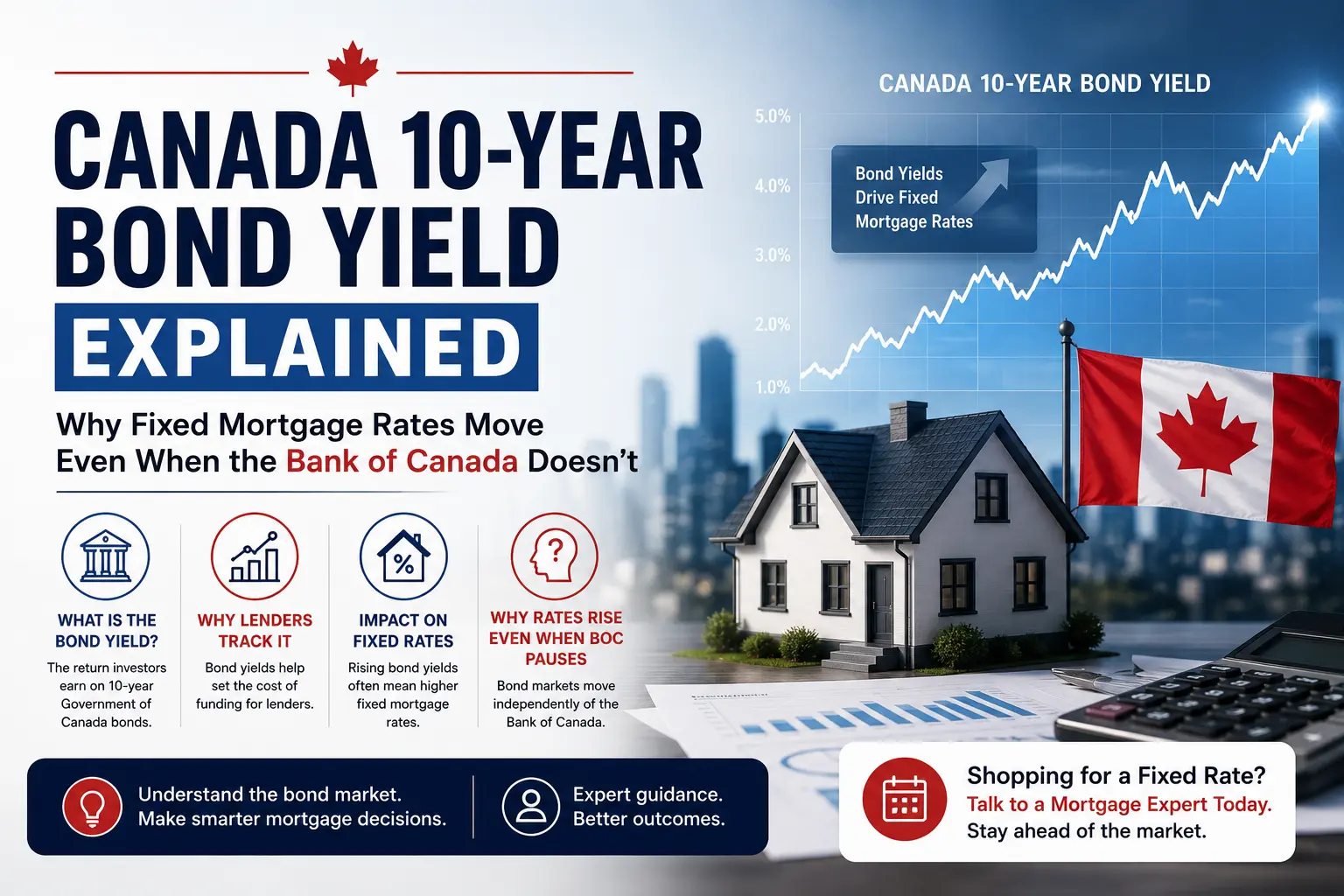
Canada 10 Year Bond Yield is one of the most important indicators affecting fixed mortgage rates in Canada. While many borrowers focus on the Bank of Canada, bond yields often explain why fixed mortgage rates rise or fall even when the central bank makes no changes.
When mortgage rates rise, most Canadians immediately look at the Bank of Canada.
But that is only part of the story.
In reality, many fixed mortgage rate changes happen because of something entirely different:
The Canada 10-year bond yield.
This is one of the most important indicators in the mortgage market, yet it is also one of the least understood.
Many borrowers ask:
“If the Bank of Canada didn’t raise rates, why did my lender increase fixed mortgage rates?”
The answer usually comes back to bond yields.
Understanding how bond yields work can help borrowers:
- Make better mortgage decisions
- Time rate holds more effectively
- Understand market headlines
- Avoid costly assumptions during rate cycles
Quick Answer: What Is the Canada 10-Year Bond Yield?
The Canada 10-year bond yield represents the return investors earn by purchasing Government of Canada 10-year bonds.
In simple terms:
- Investors lend money to the Canadian government.
- The government pays interest.
- The return investors receive is called the bond yield.
When investors demand higher returns, bond yields rise.
When investors are comfortable accepting lower returns, bond yields fall.
This matters because lenders closely watch these yields when pricing fixed mortgages.
Why Mortgage Lenders Track Bond Yields
Mortgage lenders borrow and manage money long before they lend it to borrowers.
To determine mortgage pricing, lenders monitor:
- Government bond yields
- Inflation expectations
- Economic growth forecasts
- Employment data
- Global financial markets
- Investor sentiment
Bond yields act as a benchmark for borrowing costs.
When bond yields increase:
- Lending becomes more expensive.
- Fixed mortgage rates often move higher.
When bond yields decrease:
- Fixed mortgage rates often move lower.
The relationship is not perfectly identical, but it is closely connected.
The Connection Between Bond Yields and Fixed Mortgage Rates
This is the relationship most borrowers need to understand.
Fixed Mortgage Rates Are Largely Influenced By Bond Yields
Variable-rate mortgages generally follow:
- Prime Rate
- Bank of Canada policy decisions
Fixed-rate mortgages primarily follow:
- Government bond yields
Especially:
- 5-year Government of Canada bond yields
However, the broader 10-year bond market often influences lender expectations and mortgage pricing trends.
This is why mortgage headlines sometimes seem confusing.
Why Rates Rise Even When the Bank of Canada Pauses
This is one of the most searched mortgage questions in Canada.
Many borrowers assume:
“If the Bank of Canada doesn’t change rates, fixed mortgage rates should stay the same.”
That assumption is wrong.
The Bank of Canada controls:
- Overnight lending rates
- Prime rate direction
But bond markets operate independently.
Bond yields respond to:
- Inflation data
- Employment reports
- Economic growth
- Government spending
- Global markets
- Investor confidence
Because of this:
- The Bank of Canada can pause.
- Bond yields can still rise.
- Fixed mortgage rates can still increase.
This happens regularly.
In fact, recent Canadian mortgage markets have experienced exactly this situation. Bond market volatility has often moved fixed mortgage pricing even when Bank of Canada policy remained unchanged.
Canada 10-Year Bond Yield vs Bank of Canada Rate
Many borrowers confuse these two completely different indicators.
| Canada 10-Year Bond Yield | Bank of Canada Rate |
|---|---|
| Driven by investors | Set by Bank of Canada |
| Influences fixed mortgages | Influences variable mortgages |
| Changes daily | Changes only at scheduled announcements |
| Reflects future expectations | Reflects current monetary policy |
| Market-driven | Central bank-driven |
Understanding this difference helps explain why mortgage news often appears contradictory.
Real Example: How Bond Yield Changes Affect Fixed Mortgage Rates
Let’s look at a simplified example.
Scenario
Mortgage Amount:
$600,000
Term:
5-Year Fixed
Amortization:
25 Years
Example 1: Bond Yield Falls
If bond yields decline significantly:
Lenders may reduce fixed mortgage pricing.
Example:
- Fixed Rate: 4.80%
- Monthly Payment: Lower
Borrowers benefit through:
- Reduced monthly costs
- Improved qualification
- Better affordability
Example 2: Bond Yield Rises
If bond yields rise sharply:
Lenders may increase fixed mortgage rates.
Example:
- Fixed Rate: 5.05%
- Monthly Payment: Higher
Even a modest rate increase can add thousands of dollars over a mortgage term.
Why Borrowers Get Confused by Mortgage Headlines
This is probably the biggest source of confusion in today’s mortgage market.
News headline:
“Bank of Canada Holds Rates.”
Borrowers assume:
“Mortgage rates won’t change.”
A week later:
Fixed mortgage rates increase.
What happened?
Usually:
- Inflation data surprised markets.
- Bond yields rose.
- Lenders adjusted fixed-rate pricing.
The Bank of Canada never changed anything.
The bond market did.
This is why watching only Bank of Canada announcements provides an incomplete picture.
What Causes Bond Yields to Rise?
Several factors can push bond yields higher.
Inflation Concerns
If investors believe inflation may remain elevated:
- They demand higher returns.
- Bond yields rise.
Strong Economic Growth
A stronger economy can increase:
- Consumer spending
- Employment growth
- Inflation pressure
This often pushes yields higher.
Government Borrowing
Large government borrowing programs can increase bond supply.
Higher supply sometimes places upward pressure on yields.
Global Market Events
Canadian bond markets are connected to:
- U.S. Treasury markets
- Global inflation trends
- International economic events
Global developments can influence Canadian yields even when domestic conditions remain stable.
What Causes Bond Yields to Fall?
Bond yields often fall when investors seek safety.
Common reasons include:
- Economic slowdowns
- Recession concerns
- Lower inflation expectations
- Weak employment data
- Market uncertainty
When yields decline, fixed mortgage pricing often becomes more competitive.
What Home Buyers Should Watch
Most borrowers do not need to monitor bond markets daily.
However, if you are:
- Shopping for a mortgage
- Approaching renewal
- Considering refinancing
- Buying within the next few months
then bond yield trends become important.
Rapid yield increases can lead to:
- Higher fixed rates
- Reduced affordability
- Lower qualification amounts
Fixed Mortgage Shoppers: Why Timing Matters
Many buyers focus entirely on today’s rate.
Smart borrowers also watch:
- Yield direction
- Market trends
- Rate hold opportunities
- Closing timelines
A mortgage pre-approval can often lock in a rate for up to 120 days, helping protect borrowers from rising fixed-rate environments.
Should Borrowers Worry About Bond Yield Changes?
Not necessarily.
Borrowers should understand them — not fear them.
Bond yields move constantly.
The bigger question is:
Does your mortgage strategy still fit your goals?
A small rate increase does not automatically mean:
- Rush into a mortgage
- Panic-lock rates
- Refinance immediately
Mortgage decisions should always be tied to long-term financial objectives.
Frequently Asked Questions
Does the Canada 10-Year Bond Yield Directly Set Mortgage Rates?
No.
Lenders use bond yields as a benchmark, but they also consider:
Competition
Profit margins
Funding costs
Risk factors
Why Do Fixed Rates Change Before a Bank of Canada Announcement?
Because bond markets move daily.
Lenders react to bond market expectations before the Bank of Canada actually announces policy changes.
Do Variable Mortgage Rates Follow Bond Yields?
Generally no.
Variable mortgages are more closely connected to:
Prime Rate
Bank of Canada overnight rate decisions
Can Fixed Mortgage Rates Fall While Prime Rate Stays High?
Yes.
If bond yields decline, fixed mortgage rates can fall even if prime remains unchanged.
Is the Bond Yield More Important Than the Bank of Canada Rate?
For fixed-rate borrowers, often yes.
For variable-rate borrowers, the Bank of Canada usually matters more.
When to Speak With a Mortgage Expert
Consider speaking with a mortgage professional when:
- You’re shopping for a fixed mortgage
- Bond yields are rising rapidly
- Your rate hold is about to expire
- You’re approaching renewal
- You’re considering refinancing
- You’re comparing fixed versus variable options
The earlier you review your options, the more flexibility you usually have.
Final Thoughts: Bond Yields Explain What Most Mortgage Headlines Don’t
The Canada 10-year bond yield is one of the most important forces behind fixed mortgage pricing.
While borrowers often focus exclusively on the Bank of Canada, bond markets frequently move first.
Understanding this relationship helps explain why:
- Fixed rates can rise when the Bank of Canada pauses.
- Mortgage pricing changes without major announcements.
- Bond market news matters to home buyers.
The most successful borrowers do not try to predict every rate movement.
They focus on building a mortgage strategy that works regardless of where rates move next.
Writing style and editorial structure referenced from uploaded Ratehub-style mortgage content for natural Canadian financial publishing tone and readability.