Table of Contents
prime rate canada history: Why It Matters More Than Most Borrowers Realize
When Canadians hear:
“The Bank of Canada changed rates.”
most people immediately think:
- Mortgage payments
- Variable rates
- Borrowing costs
- Housing affordability
But what actually affects many mortgages directly is the prime rate.
Prime rate changes influence:
- Variable-rate mortgages
- Lines of credit
- HELOCs
- Some business loans
- Adjustable-rate borrowing
And during periods of rising or falling interest rates, understanding how prime rate works becomes critical for homeowners and buyers.
Many borrowers focus only on:
- “Should I lock in?”
- “Will rates drop?”
- “Should I worry?”
But understanding how prime rate actually works helps borrowers make better long-term decisions — especially during volatile rate cycles.
What Is the Prime Rate in Canada?
The prime rate is the interest rate Canadian banks use as a baseline for lending products with variable interest rates.
It is heavily influenced by the:
- Bank of Canada overnight rate
When the Bank of Canada changes its benchmark rate:
- Major banks usually adjust their prime rate shortly after.
How Banks Use Prime Rate
Banks do not lend variable mortgages exactly at prime.
Instead, they use:
Prime ± adjustment
Example:
- Prime rate = 5.20%
- Variable mortgage = Prime – 0.90%
Final mortgage rate:
= 4.30%
This is why borrowers hear terms like:
- Prime minus 1%
- Prime plus 0.25%
- Prime minus 0.70%
The lender’s adjustment depends on:
- Market conditions
- Borrower profile
- Loan type
- Risk assessment
- Competition
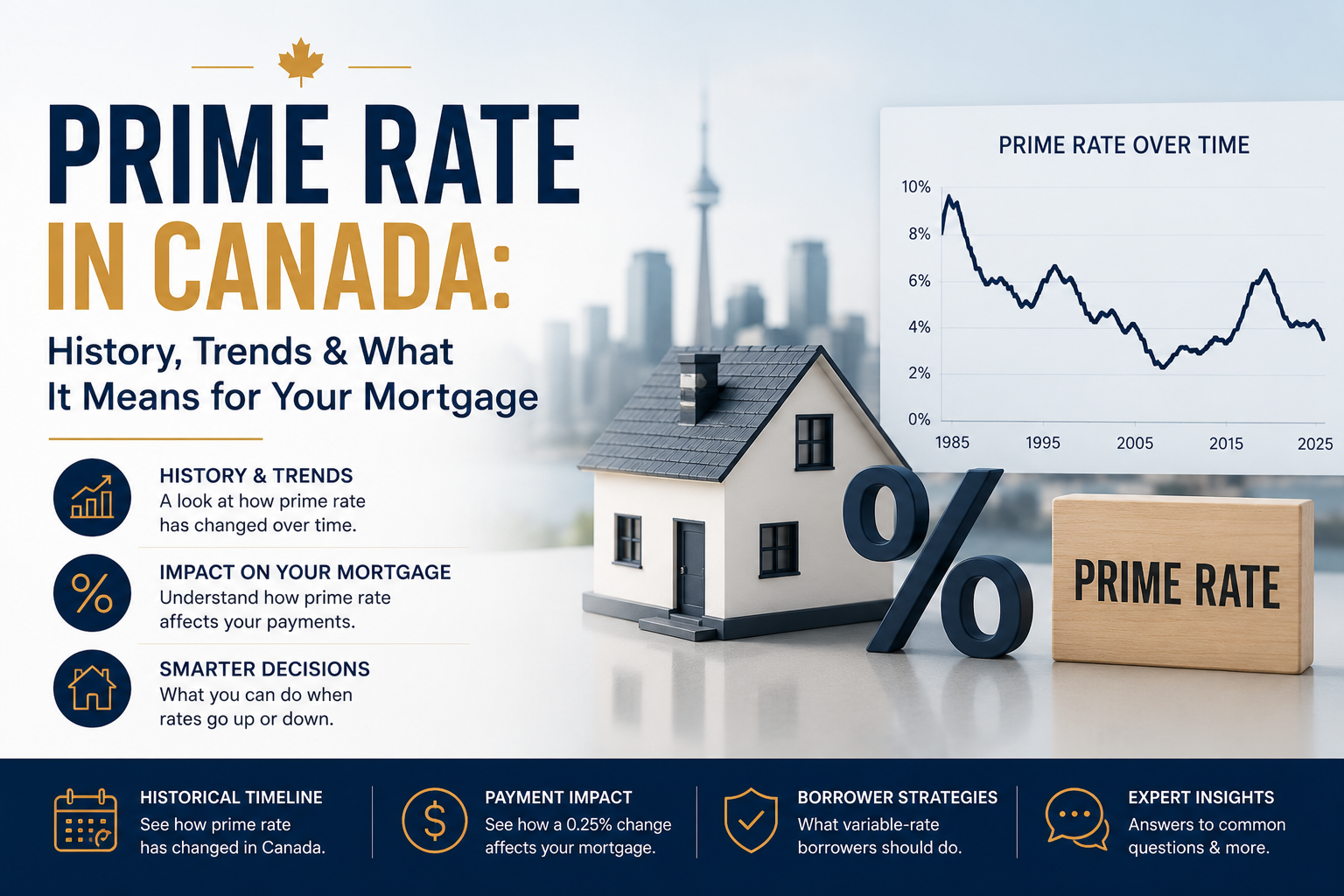
Prime Rate Canada History: Simple Historical Trend
Canada’s prime rate has changed dramatically over the decades depending on:
- Inflation
- Economic growth
- Recessions
- Housing market conditions
- Bank of Canada policy
Simplified Historical Timeline
Early 1980s
- Prime rates reached extremely high levels
- Double-digit mortgage rates became common
- Inflation was a major issue
1990s to Early 2000s
- Rates gradually stabilized lower
- Borrowing became more affordable
2008 Financial Crisis
- Major rate cuts introduced
- Prime rate dropped significantly to stimulate the economy
2020 Pandemic Period
- Emergency rate cuts pushed borrowing costs very low
- Variable mortgage demand surged
2022–2024 Rate Hike Cycle
- Rapid inflation triggered aggressive Bank of Canada increases
- Prime rate rose sharply
- Variable mortgage payments increased significantly
2025–2026 Stabilization Period
- Markets began adjusting toward more stable rate expectations
- Borrowers shifted focus toward affordability and refinancing strategy
Why Prime Rate Changes Matter for Variable Mortgages
Variable-rate mortgages are directly tied to prime.
When prime changes:
- Borrowing costs change
- Interest portions shift
- Monthly payments may increase or decrease
- Amortization can extend on some mortgage types
This impacts:
- Existing homeowners
- Buyers qualifying under stress tests
- Refinancers
- Investors
Example: How a 0.25% Prime Rate Change Affects a $600K Mortgage
Let’s look at a simplified example.
Scenario
Mortgage Amount:
$600,000
Amortization:
25 years
Variable Mortgage Rate:
Based on prime
If Prime Rate Increases by 0.25%
Monthly payment impact may increase by roughly:
- $75–$95 per month
(depending on amortization and mortgage structure)
That may not sound huge initially.
But over time:
- Multiple increases compound quickly
- Cash flow pressure rises
- Qualification becomes harder
- Total borrowing costs increase
Why This Matters
During aggressive rate cycles, several consecutive increases can dramatically change affordability.
This is exactly what many Canadian borrowers experienced during recent tightening cycles.
How Variable Mortgage Types Behave Differently
This is where many borrowers get confused.
Not all variable mortgages behave the same way.
Adjustable Payment Variable Mortgages
With adjustable-rate mortgages:
- Monthly payments change when prime changes.
If rates rise:
- Payments rise.
If rates fall:
- Payments fall.
Fixed Payment Variable Mortgages
With fixed-payment variable mortgages:
- Monthly payment may stay unchanged initially.
But:
- More of the payment goes toward interest
- Less goes toward principal
If rates rise aggressively:
- Trigger rate issues may occur
- Payments may eventually need adjustment
This became a major issue during recent rate increases.
What Existing Variable-Rate Borrowers Should Do When Prime Changes
Many borrowers panic during rate changes.
That usually leads to emotional decisions.
Instead, borrowers should evaluate:
- Cash flow stability
- Remaining mortgage term
- Penalty exposure
- Fixed vs variable spread
- Long-term plans
- Stress tolerance
Review Your Mortgage Structure
Borrowers should understand:
- Their actual variable discount
- Trigger rate exposure
- Penalty calculations
- Remaining amortization
- Flexibility options
Many homeowners do not know these details until problems arise.
Avoid Emotional Mortgage Decisions
One of the biggest mistakes borrowers make is reacting emotionally to headlines.
Example:
- Locking into fixed rates at peak panic moments
- Refinancing without penalty review
- Ignoring long-term strategy
Mortgage decisions should be based on:
- Financial goals
- Cash flow
- Time horizon
- Risk tolerance
—not fear-driven headlines.
Should Borrowers Worry About Prime Rate Changes?
Borrowers should respect rate changes — not panic over them.
Interest rate cycles are normal.
The real issue is whether:
- Your mortgage structure fits your financial situation
- Your cash flow can absorb changes
- Your long-term plan still works
Some borrowers handle variable rates comfortably.
Others prefer payment certainty.
Neither approach is universally right or wrong.
Why Some Borrowers Still Prefer Variable Mortgages
Despite volatility, many borrowers still choose variable rates because:
- Historically, variable rates have often performed competitively over long periods
- Penalties are usually lower
- Flexibility may be better
- Future rate declines remain possible
But variable mortgages require stronger cash flow discipline.
Why Some Borrowers Prefer Fixed Rates
Fixed-rate borrowers prioritize:
- Stability
- Predictability
- Budget consistency
- Reduced payment shock risk
This matters especially for:
- Tight monthly budgets
- First-time buyers
- Families with limited flexibility
- High-debt households
Prime Rate & Mortgage Qualification
Prime rate changes also affect:
- Mortgage stress test qualification
- Affordability calculations
- Maximum approval amounts
When rates rise:
- Borrowing power usually falls.
That impacts:
- First-time buyers
- Move-up buyers
- Refinancers
- Investors
FAQ
Does the Bank of Canada Directly Set Prime Rate?
No.
The Bank of Canada sets the overnight lending rate.
Commercial banks then adjust their own prime rates based on it.
Do All Banks Have the Same Prime Rate?
Usually similar — but not always identical.
Most major Canadian banks move closely together.
Do Fixed Mortgage Rates Follow Prime Rate?
Not directly.
Fixed mortgage rates are influenced more heavily by:
Bond yields
Market expectations
Inflation outlook
Should I Switch From Variable to Fixed When Prime Changes?
Not automatically.
The decision depends on:
Your risk tolerance
Financial goals
Remaining mortgage term
Current fixed-rate pricing
Cash flow stability
Can Prime Rate Changes Affect HELOCs?
Yes.
Most HELOCs are directly tied to prime rate.
When prime rises:
HELOC borrowing costs usually rise immediately.
When to Speak With a Mortgage Expert During Rate Cycles
Borrowers should consider reviewing their mortgage when:
- Prime rates change rapidly
- Monthly payments become difficult
- Renewal is approaching
- Refinancing opportunities appear
- Variable-rate stress becomes uncomfortable
- Penalty analysis is needed
- Debt consolidation becomes necessary
The earlier borrowers review options, the more flexibility they usually have.
Final Thoughts: Prime Rate Changes Are About Strategy — Not Panic
Prime rate changes affect millions of Canadian borrowers.
But the smartest mortgage decisions are rarely made emotionally.
The real focus should be:
- Mortgage structure
- Cash flow flexibility
- Long-term planning
- Penalty awareness
- Financial stability
A strong mortgage strategy is designed to survive changing rate environments — not depend on perfect market timing.
Because in Canada’s mortgage market:
The right structure often matters more than predicting rates perfectly.
Writing style and editorial structure referenced from uploaded Ratehub-style mortgage content for natural Canadian financial publishing tone and readability.