The minimum down payment in Ontario depends on the purchase price of the home. It is not always a flat 5%.
Table of Contents
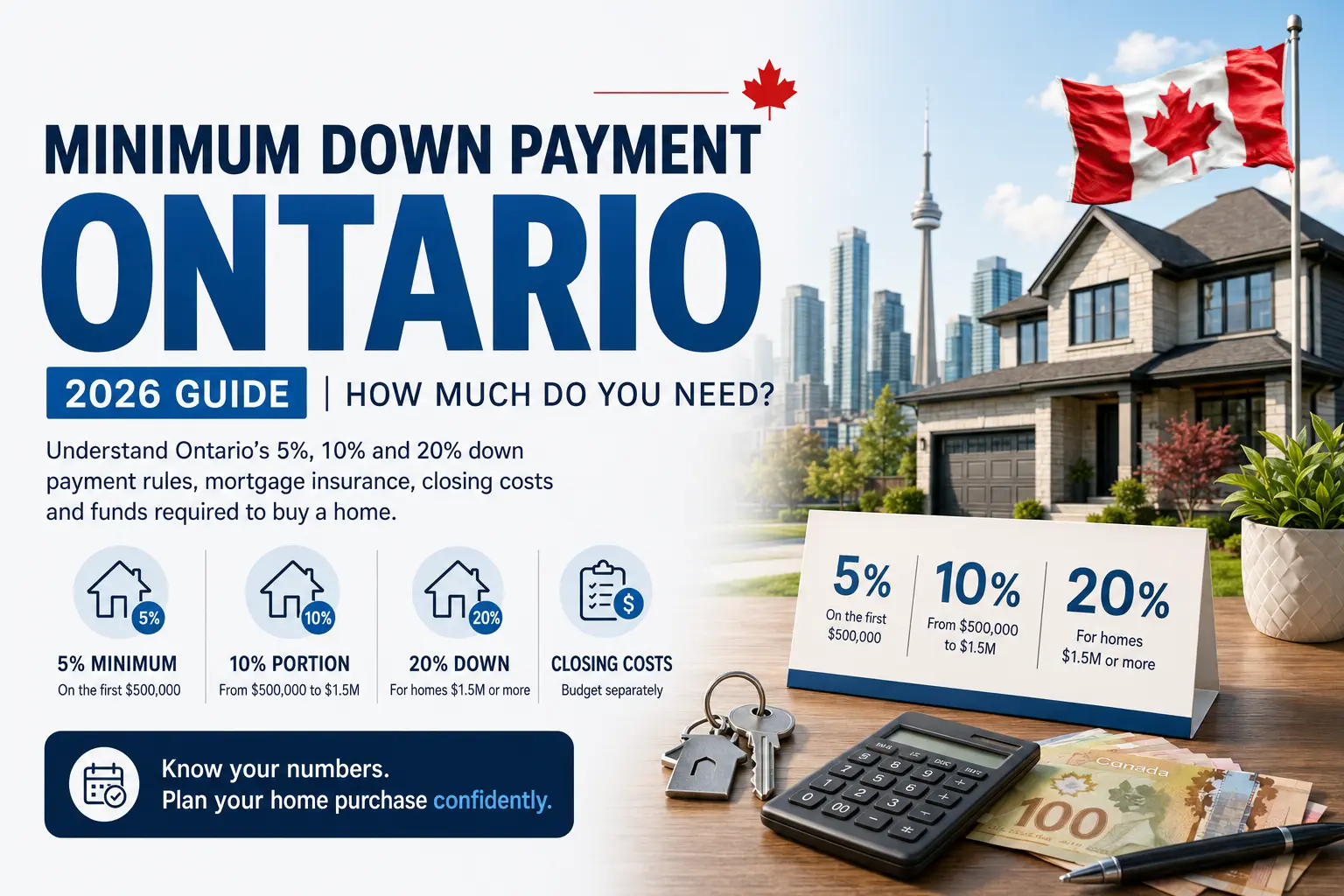
For an owner-occupied property priced at $500,000 or less, the minimum is generally 5% of the purchase price. For a property priced above $500,000 but below $1.5 million, the buyer generally needs 5% of the first $500,000 and 10% of the remaining amount. At $1.5 million or more, the minimum down payment is generally 20%.
That sounds straightforward. The part that catches buyers off guard is that the down payment is not the same as the total cash required to close.
A buyer may save exactly the minimum down payment, receive a pre-approval and still come up short because land transfer tax, legal fees, mortgage-insurance tax and other closing costs were not included in the plan.
There is another complication: having the money is not enough. The lender must also be satisfied with where it came from.
This guide explains the minimum down payment Ontario buyers need at different price points, how insured and uninsured mortgages differ, what lenders may request as proof, and which mistakes can delay an approval.
Quick Answer: What Is the Minimum Down Payment in Ontario?
The standard minimum down-payment structure for an eligible owner-occupied home is:
| Purchase price | General minimum down payment |
|---|---|
| $500,000 or less | 5% of the purchase price |
| Above $500,000 but below $1.5 million | 5% of the first $500,000, plus 10% of the portion above $500,000 |
| $1.5 million or more | 20% of the purchase price |
These are minimum thresholds, not guaranteed approval terms.
A lender or mortgage insurer may require a larger down payment because of the borrower’s credit, income documentation, debt level, property type or overall risk.
Someone who is self-employed, has limited credit history or is purchasing an unusual property should not assume the minimum will automatically be accepted.
Insured vs Uninsured Mortgage Down Payments
The size of the down payment determines whether a mortgage will generally be insured or uninsured.
Insured Mortgage
A mortgage is generally insured when the buyer puts down less than 20% and the property meets mortgage-insurance requirements.
Mortgage default insurance protects the lender, not the homeowner. It allows an eligible buyer to borrow a higher percentage of the property’s value, sometimes up to 95%.
The insurance premium is usually added to the mortgage balance rather than paid entirely in cash. Ontario sales tax charged on that premium, however, normally has to be paid as part of the buyer’s closing funds.
That tax is easy to miss because it is not included in the advertised down payment.
Uninsured Mortgage
A mortgage is generally uninsured when the buyer provides at least 20% down or when the property is not eligible for default insurance.
An uninsured mortgage avoids the mortgage-insurance premium, but it does not automatically make qualification easier.
The borrower still has to satisfy the lender’s requirements for income, credit, debt ratios, property value and the mortgage stress test.
A 20% down payment may also be required because of the transaction itself. Examples can include a home priced at $1.5 million or more, a non-owner-occupied rental property, or a property that does not meet an insurer’s guidelines.
Minimum Down Payment Ontario Examples
The calculation changes as the purchase price increases.
Example 1: Entry-Level Home Priced at $450,000
The purchase price is below $500,000, so the calculation is simple:
- Purchase price: $450,000
- Minimum percentage: 5%
- Minimum down payment: $22,500
- Mortgage before the insurance premium: $427,500
This buyer should not assume that $22,500 is all the cash required.
Legal fees, title insurance, land transfer tax after any applicable rebate, inspection costs and the Ontario tax on the mortgage-insurance premium may still have to be paid separately.
Example 2: Mid-Range Ontario Home Priced at $850,000
For a property above $500,000, the minimum is calculated in two parts:
- 5% of the first $500,000: $25,000
- 10% of the remaining $350,000: $35,000
- Minimum down payment: $60,000
The minimum down payment works out to roughly 7.06% of the purchase price—not 5%.
This is where many online estimates go wrong. Someone who simply calculates 5% of $850,000 would set aside $42,500 and be short by $17,500 before considering closing costs.
Example 3: Higher-Priced Ontario Home at $1.4 Million
The same two-part calculation applies because the price remains below $1.5 million:
- 5% of the first $500,000: $25,000
- 10% of the remaining $900,000: $90,000
- Minimum down payment: $115,000
That is roughly 8.21% of the purchase price.
At a purchase price of $1.5 million, the situation changes. The minimum would generally become 20%, or $300,000.
A difference of only $100,000 in price—from $1.4 million to $1.5 million—can therefore create a dramatic increase in the cash required.
Minimum Down Payment Is Not the Same as Cash Needed to Close
The down payment is only one part of the purchase budget.
Ontario buyers may also need money for:
- Provincial land transfer tax
- Toronto municipal land transfer tax, where applicable
- Legal fees and disbursements
- Title insurance
- Home inspection
- Appraisal
- Provincial sales tax on the mortgage-insurance premium
- Property-tax and utility adjustments
- Moving expenses
- Immediate repairs
- New-build adjustments, where applicable
First-time buyer land transfer tax rebates may reduce the amount payable, but buyers should not assume they will eliminate it entirely.
The exact amount depends on the price, municipality, ownership history and eligibility of everyone taking title.
A flat rule such as “budget 1.5% for closing costs” may be a useful starting point, but it is not reliable enough for every transaction. A Toronto purchase, a new-build closing and a resale property outside the GTA can have very different cash requirements.
The safer approach is to calculate each major cost for the specific property.
Can a Gift Be Used for the Down Payment?
Many lenders accept a non-repayable gift from an eligible family member.
A gifted down payment usually needs to be supported by:
- A signed gift letter
- The donor’s name and relationship to the buyer
- Confirmation that the money does not have to be repaid
- Evidence showing the transfer into the buyer’s account
- Bank records showing the money is available before closing
The lender may use its own gift-letter form and may request additional documents.
A common mistake is receiving the gift shortly before closing without keeping a clear record. The buyer may know the money came from a parent, but the lender cannot rely on a verbal explanation.
If the money must be repaid, it is not a true gift. It may be treated as borrowed money and included in the buyer’s liabilities.
That difference can materially change qualification.
Combining FHSA, HBP and Personal Savings
An eligible buyer may be able to combine several down-payment sources.
For example:
- FHSA withdrawal: $24,000
- HBP withdrawal from an RRSP: $30,000
- Personal savings: $20,000
- Family gift: $15,000
- Total available: $89,000
Using several sources is not automatically a problem. The problem arises when the paper trail is incomplete.
Keep:
- FHSA statements and withdrawal records
- RRSP statements and HBP withdrawal records
- Personal bank or investment statements
- Gift letters and transfer confirmations
- Records of transfers between your own accounts
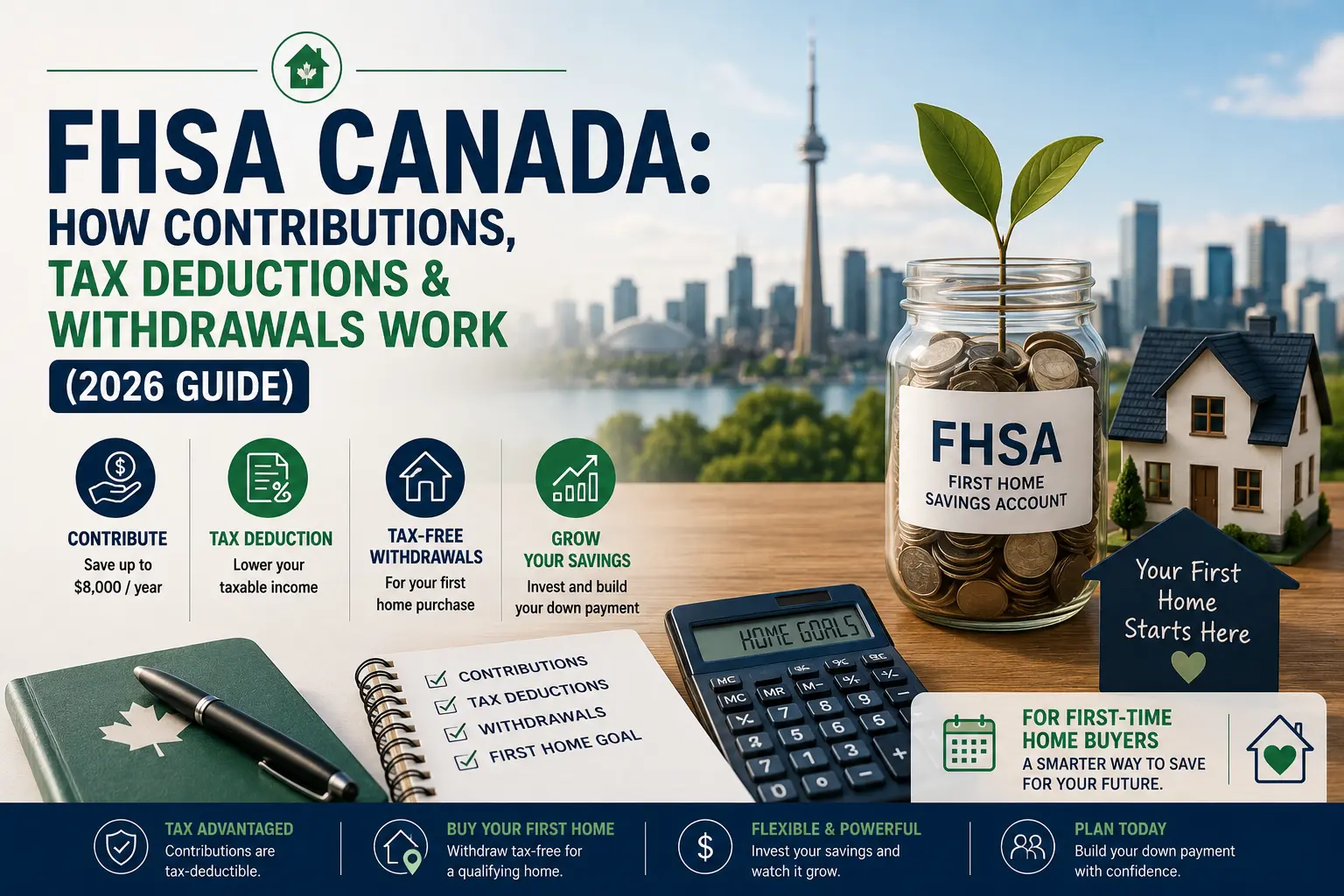
The FHSA and the Home Buyers’ Plan can be used for the same qualifying home when the applicable conditions are met.
For the detailed tax and eligibility rules, link this article to your existing FHSA Canada guide and Home Buyers’ Plan article rather than repeating them here.
Proof of Down Payment for Newcomers
Newcomers may be able to qualify with the standard minimum down payment, but lenders still need to verify the source and availability of the funds.
Documents may include:
- Canadian bank statements
- Foreign bank statements
- International wire-transfer records
- Currency-conversion records
- Sale documents for assets held abroad
- Gift documentation
- Proof of immigration or residency status
Moving money into Canada at the last minute can create delays, especially when the lender cannot clearly connect the overseas account to the borrower.
International transfers may also take longer than expected because of banking reviews, transfer limits or intermediary institutions.
Bring the money into the required account early enough to document it properly, but do not move it repeatedly without retaining the full paper trail.
Proof of Down Payment for Self-Employed Buyers
Self-employed buyers face another issue: personal savings and business funds are not always treated the same way.
A business owner may have enough money inside a corporation but still need to show that withdrawing it will not harm the business.
Depending on the lender, requested documents may include:
- Personal bank statements
- Corporate bank statements
- Business financial statements
- Articles of incorporation
- Accountant confirmation
- Evidence of retained earnings
- Proof showing how the funds moved from the business to the buyer
A large transfer from a corporate account to a personal account just before closing may raise questions about taxes, shareholder loans and business liquidity.
The funds may be usable, but the withdrawal should be planned with the lender, accountant and lawyer rather than improvised after the offer is accepted.
When Borrowed Down Payments Create Problems
Some mortgage programs may permit certain borrowed down-payment sources. That does not mean borrowing the down payment is harmless.
A personal loan, line of credit or other repayable source creates a monthly obligation. The lender generally has to include that payment when calculating affordability.
The result can be frustrating:
- Borrowing increases the cash available for the purchase.
- The new monthly payment increases the buyer’s debt ratios.
- The buyer qualifies for a smaller mortgage.
- The extra cash fails to improve the purchase budget as expected.
Borrowing may also involve a higher mortgage-insurance premium under certain insured programs.
Do not borrow the down payment without having the entire structure reviewed. The fact that a source may be technically acceptable does not mean the resulting application will qualify.
Deposit vs Down Payment: They Are Not the Same Thing
The deposit is the money submitted with or shortly after the offer to show the buyer’s commitment to the transaction.
The down payment is the total amount of the purchase price that will not be financed by the mortgage.
The deposit normally forms part of the down payment.
For example:
- Total required down payment: $60,000
- Deposit already paid with accepted offer: $25,000
- Remaining down payment due through the lawyer: $35,000
The buyer is not paying $85,000 in down payment. The $25,000 deposit is credited toward the required $60,000.
The timing is different, though.
A buyer may need the deposit within 24 hours of acceptance, long before the mortgage closes. Funds locked in an FHSA, RRSP, GIC or foreign account may not be available quickly enough.
Before making an offer, confirm:
- The expected deposit amount
- How quickly it must be delivered
- Which account it will come from
- Whether the money can be withdrawn in time
- Whether withdrawal records will satisfy the lender
A deposit can also be at risk if the buyer enters a firm agreement and later cannot obtain financing. A pre-approval does not guarantee that the lender will approve the property or the final application.
Common Ontario Down-Payment Mistakes
Calculating 5% of Every Purchase Price
The 5% rule only applies to the portion up to $500,000. Above that amount, the calculation changes.
Saving Only the Minimum Down Payment
Closing costs, the deposit and an emergency reserve must also be available.
Moving Funds Between Accounts Without Records
Frequent transfers create gaps in the paper trail. Save the statement from the sending account and the receiving account.
Treating a Family Loan as a Gift
A gift does not have to be repaid. A family loan is debt and may affect qualification.
Borrowing Before the Lender Reviews the Plan
The new loan payment may reduce the mortgage amount more than the borrowed cash helps.
Assuming the Pre-Approval Confirms the Property
The lender still has to review the property, appraisal and final documents after an offer is accepted.
Using Every Dollar at Closing
Homeownership begins with expenses. A buyer who empties every account to close has no room for moving costs, repairs or unexpected bills.
Minimum Down Payment Ontario FAQs
Can I Buy a Home in Ontario With 5% Down?
Yes, an eligible buyer may purchase an owner-occupied home priced at $500,000 or less with a minimum down payment of 5%, subject to lender and mortgage-insurer approval.
For a home above $500,000 but below $1.5 million, 5% applies only to the first $500,000. The portion above $500,000 generally requires 10%.
Do I Need 20% Down in Ontario?
Not always.
A purchase below $1.5 million may qualify with less than 20% down if it meets mortgage-insurance and lender requirements. A home priced at $1.5 million or more generally requires at least 20%.
A lender may also require 20% or more because of the property, occupancy, credit or income profile.
Can the Seller Help With My Down Payment?
A seller cannot normally replace the buyer’s required down payment with an informal payment or undisclosed rebate.
A properly disclosed vendor-take-back mortgage, purchase-price adjustment or negotiated credit may be possible in certain transactions, but it must be accepted by the primary lender, documented in the purchase agreement and reviewed by the lawyer.
A seller credit does not automatically count as the buyer’s required equity. Never agree to an undisclosed cashback arrangement.
Can I Use a Line of Credit for the Down Payment?
Possibly, under certain lender and mortgage-insurance programs.
The lender must approve the source, and the required loan payment will generally affect your debt ratios. Borrowing the down payment can therefore reduce how much mortgage you qualify for.
How Many Months of Bank Statements Will I Need?
The exact requirement varies by lender, insurer and source of funds.
Buyers are commonly asked for recent statements covering the history of the down payment, along with records explaining transfers or large deposits. The lender may request a longer history when the source is unclear.
Can I Use Cryptocurrency for a Down Payment?
Potentially, after it has been converted and properly documented.
Expect requests for exchange statements, transaction records, bank deposit evidence and an explanation of the original source. Do not convert or transfer significant crypto proceeds shortly before closing without discussing the documentation first.
Plan the Down Payment Before Making an Offer
The minimum down payment Ontario rules tell you the smallest amount that may be accepted. They do not tell you whether the lender will approve your income, whether your funds are documented properly or how much cash the lawyer will need at closing.
A useful mortgage plan should show:
- The minimum and recommended down payment
- The estimated mortgage-insurance premium
- Closing costs
- Deposit timing
- Acceptable sources of funds
- Documents still required
- The mortgage amount you may realistically qualify for
Team Done Mortgage can review your income, savings, gifted funds and target price before you begin making offers.
Request an Ontario down-payment and mortgage plan based on your actual numbers.
This article provides general information and does not constitute legal, tax or financial advice. Mortgage-insurance rules, lender policies and documentation requirements can change. Approval remains subject to lender and insurer review.