Table of Contents
The Canada commercial real estate market is beginning to show encouraging signs of recovery after several years of uncertainty. New industry reports suggest improving demand for office and industrial properties, creating fresh opportunities for investors, developers, and commercial borrowers.
Recent market data suggests the conversation is beginning to change.
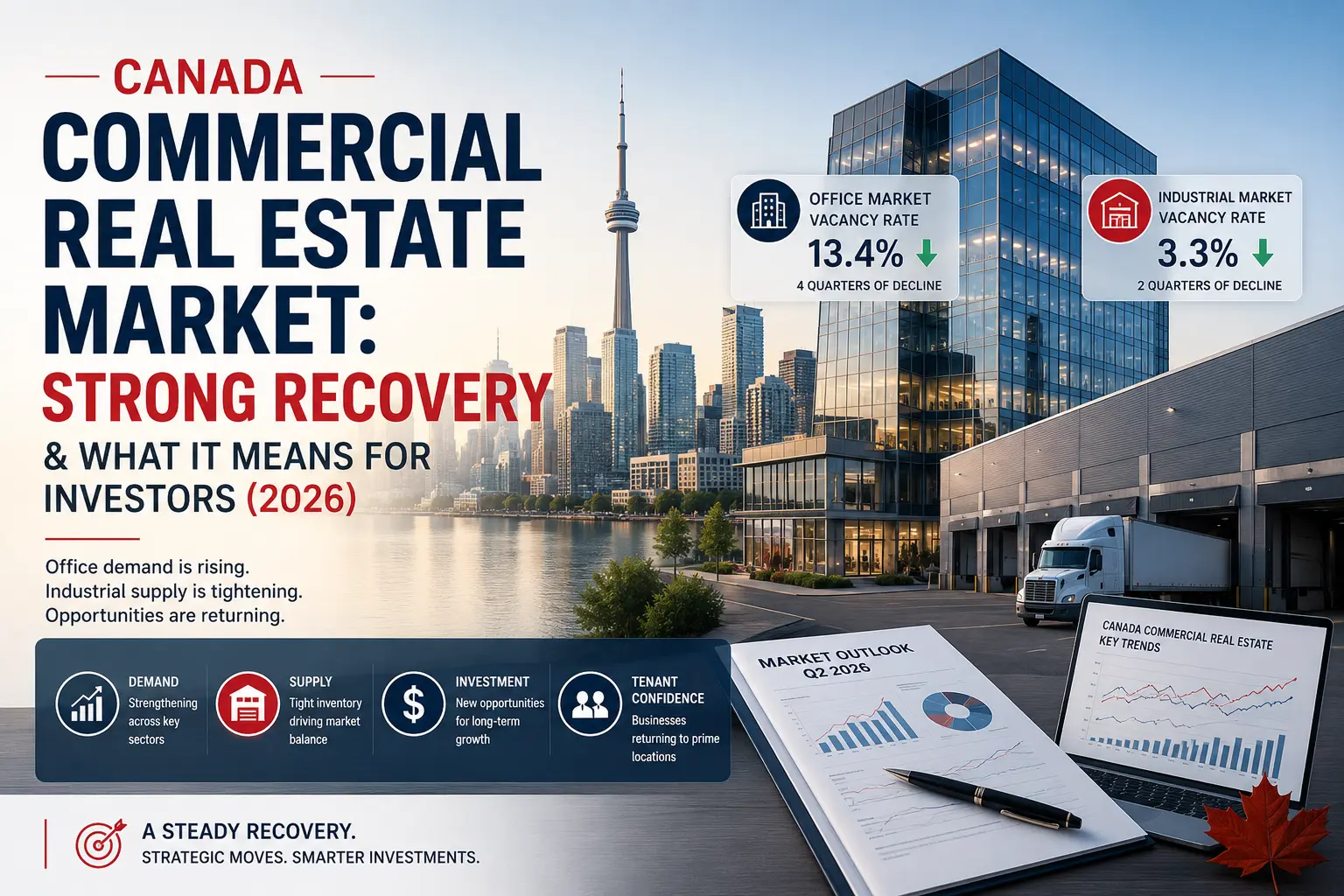
According to Colliers Canada’s latest market outlook, both the office and industrial sectors are showing encouraging signs of recovery. Office vacancy rates have continued to decline, while industrial space remains in high demand with limited available inventory.
Although every local market is different, the report points to a commercial real estate sector that appears to be stabilizing after several years of adjustment.
Office Vacancy Rates Continue to Improve
One of the most notable findings is the continued improvement in Canada’s downtown office market.
National office vacancy has declined for the fourth consecutive quarter, suggesting that more businesses are committing to physical office space again.
The strongest demand is being seen in high-quality buildings that offer:
- Modern amenities
- Transit accessibility
- Flexible workspaces
- Attractive locations for employees
Rather than eliminating offices altogether, many companies appear to be rethinking the type of office space they occupy.
For investors, this highlights an important trend: quality assets in desirable locations continue to attract tenants.
Industrial Real Estate Remains Strong
Industrial real estate has been one of Canada’s strongest-performing property sectors over the past several years.
Demand continues to be driven by:
- E-commerce
- Distribution centres
- Warehousing
- Manufacturing
- Logistics operations
Colliers reports that industrial vacancy rates have tightened again, indicating that available space remains limited in many markets.
Limited supply often creates stronger leasing conditions and can support long-term property values, particularly in established industrial corridors.
Why New Construction Is Slowing
Interestingly, while demand is improving, new commercial development has slowed considerably.
Office construction across Canada has reached one of its lowest levels in more than a decade.
Several factors have contributed to this slowdown, including:
- Higher construction costs
- Elevated financing costs
- More cautious development activity
- Changing market conditions
A reduced development pipeline means that existing high-quality properties may face less competition from new supply in the coming years.
What This Means for Commercial Property Investors
Commercial real estate cycles rarely move in a straight line.
Markets continue to adjust based on:
- Interest rates
- Economic growth
- Employment trends
- Business confidence
- Investor demand
Improving occupancy levels and constrained new supply can create opportunities for investors who are evaluating commercial acquisitions or expanding existing portfolios.
However, not every property or asset class performs equally.
Location, tenant quality, lease terms, and financing structure remain critical considerations before making any investment decision.
Financing Commercial Real Estate in Today’s Market
Financing commercial properties differs significantly from residential mortgages.
Lenders typically evaluate:
- Property cash flow
- Net operating income (NOI)
- Debt service coverage ratio (DSCR)
- Tenant mix
- Property condition
- Borrower experience
Commercial lending solutions may include:
- Traditional commercial mortgages
- CMHC-insured multi-unit financing (where applicable)
- Alternative lending
- Private lending
- Construction financing
Choosing the right financing structure can have a significant impact on long-term investment performance.
Is Now the Right Time to Invest?
There is no single answer that applies to every investor.
Some investors may view improving occupancy and limited new supply as positive long-term signals.
Others may choose to wait for additional economic certainty before expanding their portfolios.
The right decision depends on factors such as:
- Investment objectives
- Available capital
- Risk tolerance
- Financing options
- Property type
- Local market conditions
Understanding both the property and the financing strategy is essential before making a purchase.
Frequently Asked Questions
Is Canada’s commercial real estate market recovering?
Recent market reports suggest improving conditions in several commercial sectors, particularly office and industrial properties. However, recovery varies by city, property type, and local market conditions.
Why are industrial properties still in demand?
Industrial properties continue to benefit from logistics, warehousing, manufacturing, and e-commerce activity, contributing to strong tenant demand.
Are office buildings becoming attractive investments again?
Some high-quality office properties in well-connected downtown locations are seeing increased leasing activity, although performance varies significantly between markets.
Is financing commercial property different from residential mortgages?
Yes. Commercial lenders focus more heavily on property income, cash flow, tenant stability, and overall investment performance than personal income alone.
Speak With a Commercial Mortgage Expert Before Investing
Every commercial property presents a different financing scenario.
Whether you’re purchasing an office building, industrial property, mixed-use development, or investment portfolio, understanding your financing options before making an offer can help you make more informed decisions.
At Done Mortgage, we work with commercial borrowers to explore financing solutions through banks, credit unions, alternative lenders, and private lenders based on the property’s unique characteristics and the investor’s objectives.
Source inspiration: Industry developments discussed in the recent Colliers Canada market outlook as reported by Canadian Mortgage Trends. This article is an original analysis and commentary from the perspective of Done Mortgage, not a reproduction of the source material.