
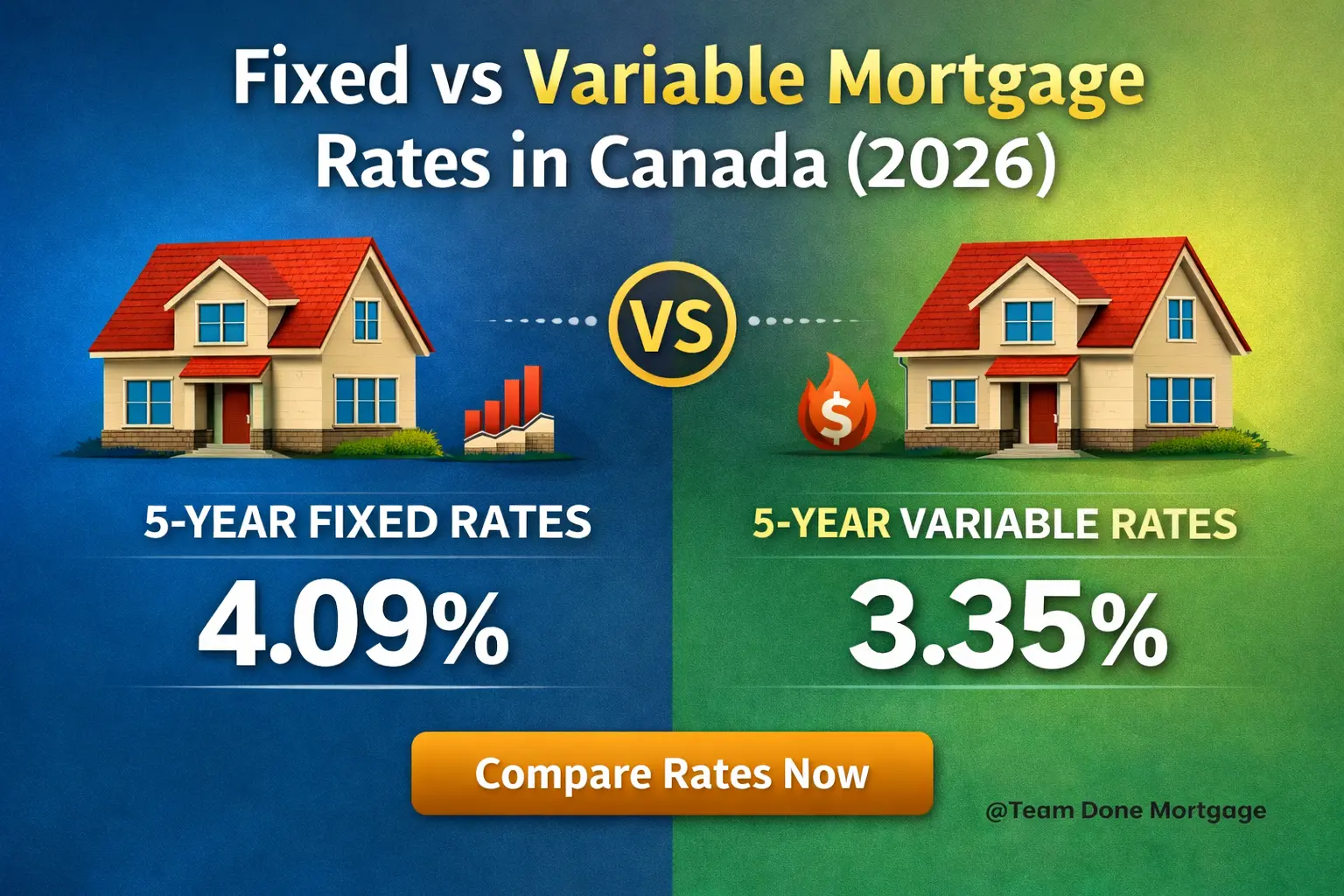
Fixed vs Variable Mortgage Rate
Canadian mortgage rates are shifting again — and if you’re buying, refinancing, or renewing, the decision between fixed and variable rates just became more important.
Over the past week, 5-year fixed mortgage rates increased by about 0.40% across major lenders. The reason is simple: rising Government of Canada bond yields, which lenders use to price fixed mortgages.
The 5-year bond yield is now hovering around 3.1%, pushing fixed mortgage rates above 4%.
Meanwhile, variable mortgage rates remain as low as 3.35%, creating a gap of roughly 0.70% between fixed and variable rates.
This leaves borrowers asking one key question:
Should you choose fixed or variable right now?
Let’s break it down.
Why Fixed Mortgage Rates Are Rising
Fixed mortgage rates follow bond markets — not the Bank of Canada directly.
Current pressure comes from:
• Global geopolitical tensions
• Oil price uncertainty
• Inflation concerns
• Delayed central bank rate cuts
• Investor risk pricing
When bond yields rise, lenders increase fixed rates to maintain margins.
This is exactly what we are seeing now.
Why Variable Mortgage Rates Still Look Attractive
Variable rates are based on the Bank of Canada overnight rate, which has remained stable.
Because of this:
• Variable rates remain cheaper today
• Payment flexibility remains higher
• Penalties remain lower
• Conversion options remain available
But cheaper does not mean safer.
If inflation persists, rate hikes remain possible.
Borrowers choosing variable must be financially prepared for payment increases.
Fixed vs Variable Mortgage: Quick Comparison
| Factor | Fixed Rate | Variable Rate |
| Payment Stability | Very Stable | Can Change |
| Starting Rate | Higher | Lower |
| Risk Level | Low | Medium |
| Break Penalty | High | Low |
| Flexibility | Limited | High |
| Conversion Option | No | Yes |
Who Should Choose Fixed Right Now
Fixed may make sense if:
• You want predictable payments
• Your budget is tight
• You dislike financial uncertainty
• You believe rates will increase
• You want long-term stability
This is the risk-management option.
Who Should Consider Variable
Variable may make sense if:
• You can handle payment fluctuations
• You want lowest starting rate
• You may sell or refinance early
• You want flexibility
• You understand interest cycles
This is the optimization strategy.
The Strategy Most Smart Borrowers Use
Experienced borrowers are not trying to predict markets.
They are:
Securing rate holds now.
A mortgage pre-approval allows you to:
• Lock today’s rates for up to 120 days
• Protect against increases
• Benefit if rates drop
• Buy time to decide
This is simply risk management.
Not speculation.
The Real Risk Most Borrowers Ignore
The biggest mistake borrowers make:
Waiting.
Mortgage markets move faster than most people expect.
Every 0.25% increase costs roughly:
$15–$18 per $100,000 borrowed monthly
On a $700K mortgage:
That’s about $105 more per month.
Waiting can be expensive.
What Done Mortgage Clients Are Doing Right Now
Borrowers working with Done Mortgage are currently:
• Securing rate holds
• Comparing fixed vs variable scenarios
• Stress testing payments
• Reviewing renewal strategies
• Structuring approvals early
The goal is simple:
Control risk instead of reacting later.
Get Your Mortgage Options Reviewed (No Obligation)
Whether you’re:
• Buying
• Renewing
• Refinancing
• Self-employed
• Previously declined
Getting a second opinion can save thousands.
Book a quick mortgage review and see your real options.
Check My Mortgage Options
FAQ
Are fixed mortgage rates going up in Canada?
Yes. Fixed rates are increasing due to rising bond yields driven by inflation concerns and global uncertainty.
Are variable mortgage rates cheaper right now?
Yes. Variable rates remain lower than fixed rates, but carry risk if the Bank of Canada raises rates.
Should I lock my mortgage rate now?
If you are buying or renewing within 4 months, securing a rate hold is generally recommended to protect against increases.
Can I switch from variable to fixed later?
Most lenders allow conversion from variable to fixed without penalty.