
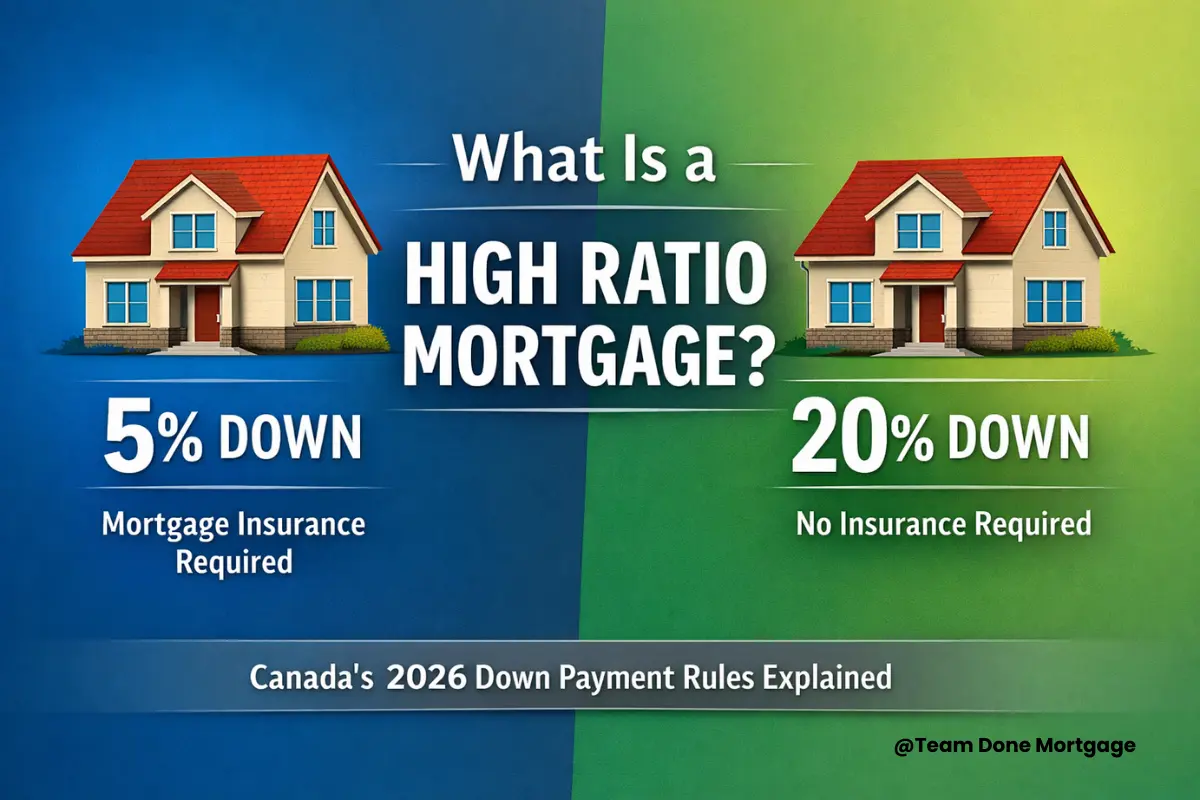
Buying a home in Canada doesn’t always require a 20% down payment. In fact, many buyers, especially first-time home buyers in Ontario and the GTA purchase homes with far less.
If your down payment is less than 20% of the purchase price, your mortgage is considered a high ratio mortgage.
Here’s what that actually means.
What Is a High Ratio Mortgage? (Simple Definition)
A high ratio mortgage is a home loan where the buyer puts down less than 20% of the purchase price. Because the lender is taking on more risk, the mortgage must be insured by a government-backed mortgage insurance provider. The insurance premium is added to the mortgage amount.
Why Mortgage Insurance Exists
Banks and lenders don’t want to take on the full risk of default when the borrower has less equity in the property.
To reduce this risk, the federal government supports mortgage insurance providers such as:
- CMHC (Canada Mortgage and Housing Corporation)
- Sagen
- Canada Guaranty
All three serve the same purpose:
They insure the lender — not the borrower — against default.
What Does “High Ratio” Mean? (Real Numbers Example)
Let’s break it down with a simple example:
Purchase Price: $1,000,000
Down Payment: $100,000 (10%)
Mortgage Amount: $900,000
Because the down payment is under 20%, mortgage insurance is required.
CMHC Insurance Premium (approx.): $29,700
Total Mortgage Added to Principal: $929,700
That $29,700 premium is rolled into your mortgage — and interest is paid on it over 25–30 years.
Minimum Down Payment Rules in Canada (2026)
For homes priced:
- Under $500,000 → Minimum 5% down
- $500,000 to $1,499,999 → 5% on first $500k + 10% on remaining
- $1.5M+ → Minimum 20% down (insurance not allowed)
So yes — you can legally purchase a home under $1.5M with less than 20% down.
Real Scenario: 5% vs 10% vs 15% Down
Let’s compare the impact:
| Scenario 1 – 5% Down | Scenario 2 – 10% Down | Scenario 3 – 15% Down |
| Purchase Price: $1,000,000 Down Payment: $50,000 Mortgage: $950,000 Insurance Premium: ~$39,900 Total Mortgage: ~$989,900 | Down Payment: $100,000 Mortgage: $900,000 Insurance Premium: ~$29,700 Total Mortgage: ~$929,700 | Down Payment: $150,000 Mortgage: $850,000 Insurance Premium: ~$25,500 Total Mortgage: ~$875,500 |
The lower the down payment, the higher the insurance premium percentage.
Common Mistakes Borrowers Make
- Not realizing the insurance premium increases their mortgage from day one
- Not understanding they pay interest on that premium
- Focusing only on qualifying — not long-term cost
- Ignoring total ownership costs (closing costs, property taxes, maintenance)
Many first-time buyers in Toronto and Brampton don’t realize closing costs can add another 3–4% of the purchase price.
Pros of a High Ratio Mortgage
- Allows you to buy sooner
- Ideal for buyers without 20% saved
- Lower interest rates (insured mortgages often get better pricing)
- Keeps savings available for investment or emergencies
Cons of a High Ratio Mortgage
- 2–4% insurance premium added to mortgage
- Higher total interest paid over time
- Less equity initially
- Selling early may feel expensive due to added premium
Who Should Consider a High Ratio Mortgage?
This option may make sense if:
- You’re a first-time buyer
- You don’t have family support for gifting
- You want to stop paying rent
- You can earn better returns investing excess capital elsewhere
It may not be ideal if:
- You plan to sell within a short timeframe
- You already have close to 20% saved
- You’re stretching affordability limits
Is a High Ratio Mortgage Bad?
No.
For many families in Ontario, it’s the only realistic way to enter the housing market. It’s not a “bad” mortgage — it’s simply a structured program designed to help Canadians buy homes with smaller down payments.
The key is understanding the cost — not avoiding it blindly.
Should You Speak to a Mortgage Expert First?
Yes.
Online calculators don’t account for:
- Income structure (especially self-employed)
- Debt ratios
- Future rate changes
- Closing costs
- Refinance strategy
- Renewal planning
A mortgage is often the largest financial decision you’ll ever make. Structured advice can prevent mistakes that cost tens of thousands of dollars.
If you’re buying in Toronto, Brampton, Mississauga or anywhere in the GTA, working with a licensed mortgage broker can help you compare insured and uninsured options across multiple lenders — not just one bank.
Frequently Asked Questions
Does mortgage insurance protect me?
No. It protects the lender. But it enables you to qualify with a smaller down payment.
Do insured mortgages have better rates?
Often yes. Lenders offer slightly better rates on insured mortgages because they are lower risk to the bank.
Can I avoid insurance by putting 19% down?
No. Insurance is required below 20%.
Is mortgage insurance refundable?
No. The premium is not refundable once added.
Final Thoughts
A high ratio mortgage isn’t about whether you can put 20% down — it’s about whether you should.
For many Ontario buyers, entering the market earlier outweighs the insurance cost. For others, waiting may make more financial sense.
Understanding the numbers — and your long-term goals — is what truly matters.
If you’d like a structured breakdown of your specific situation, Team Done Mortgage can help you review insured vs uninsured scenarios before you commit.